What 100 viral LinkedIn posts reveal about reach in 2026
June 25, 2026
Over two weeks, I examined one hundred posts that had genuinely spread: shared widely, saved often, and written by founders, marketers, and experts without advertising budgets or large existing audiences.
What I was looking for was not inspiration, but structure: a way to make clarity repeatable and publishing decisions more intentional. If performance were truly random, the strongest posts would have nothing in common. In practice, almost every one of them satisfied the same small set of conditions, and the posts that underperformed tended to fail those same checks.
I turned what I found into a two-part framework. The first part governs the writing; the second governs the platform. Here is the review worth running before publishing anything.
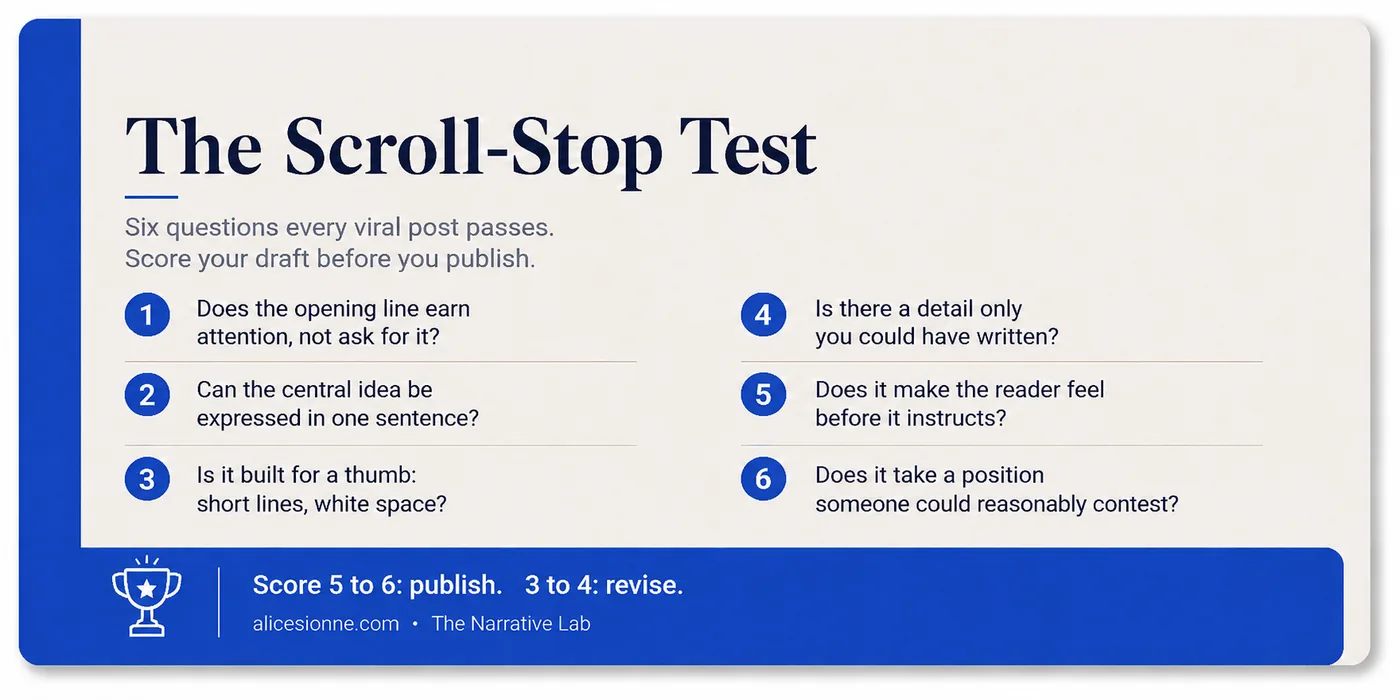
The scroll-stop test: six rules for the text
1. Does the opening line earn attention rather than ask for it? LinkedIn reveals only the first line or two before the reader has to choose to expand. That sentence is not an introduction; it is the entire proposition. The posts that spread opened with a specific: an admission, a precise figure, or an unfashionable view. A cautious opening communicates caution, and caution rarely spreads.
2. Can the central idea be expressed in a single sentence? The weakest posts attempted several arguments at once and diluted all of them. The strongest committed to one idea and developed it with patience. If your thesis resists summary, the piece is carrying more than it can deliver.
3. Is it built for a thumb? Most of your audience will meet the post on a small screen, between other tasks, with limited attention. Dense paragraphs are abandoned before they are understood. Generous spacing, short lines, and a clear visual rhythm are not stylistic preferences; they are what make comprehension possible in that environment.
4. Does it contain a detail only you could have written? General advice is interchangeable, and interchangeable is forgettable. A specific, lived detail (a date, a number, an exact moment of doubt) signals authenticity and offers the reader something they cannot find elsewhere. Specificity is the most dependable defence against sounding like everyone else.
5. Does it engage the reader emotionally before it instructs them? Audiences rarely share information for its own sake. They share what made them feel something, and they carry the lesson along with it. Leading with a moment of tension, difficulty, or change earns genuine attention, and the insight lands more firmly once the reader is already invested.
6. Does it take a position someone could reasonably contest? A statement no one could dispute gives no one a reason to respond. The posts that generated real discussion took a clear view and accepted that some readers would disagree. A defensible, well-argued position is not a risk to your credibility; it is what gives the comment section something to engage with, and considered disagreement is one of reach's most powerful engines.
The 2026 algorithm: three rules for the platform
The six questions above govern the text, but they do not, on their own, secure distribution. Three practices outside the writing matter almost as much.
- Keep external links out of the body. Platforms consistently limit the reach of content that sends people away. The algorithm rewards dwell time and saves, not exits. Placing your link in the first comment avoids the penalty without hiding the resource.
- The first hour decides everything. A post's eventual reach is shaped disproportionately by its performance in the first sixty to ninety minutes. The accounts that won showed up the moment they posted. Posting and walking away leaves reach on the table.
- The comments are the content. The most-seen posts had authors who treated the comment section as an extension of the post itself. They asked follow-ups, invited pushback, and kept the thread alive. A post that finishes a thought ends the exchange. A post that offers the reader the floor begins one.
How to read your score
Run your next draft through the six writing rules above. Five to six: publish. Three to four: the idea is sound but the execution is unfinished, so revise the questions it failed. Zero to two: you have the beginning of a thought rather than a post, which is a perfectly good place to start, simply not yet a place to publish from.
The score is not a judgment. It is a reason to slow down before pressing publish. Reach on LinkedIn is not entirely predictable. But clarity, relevance, specificity, and conversation are choices you can make before the post ever goes live.
The truth
Chasing virality is a fragile growth strategy.
The accounts that grew most durably were not pursuing the largest possible audience. They are the ones becoming recognisable to a specific group of people over time.
The posts that travel furthest are not always the ones that build the most trust. But the people who repeatedly show up with clarity, usefulness, and a point of view become easier to remember, recommend, and return to.
Reaching the right hundred people repeatedly can be more valuable than briefly reaching twenty thousand strangers. Virality is a distribution event. Trust is the asset.
This is the first edition of a new monthly series for The Narrative Lab, in which I take on the time-consuming research so that you do not have to.
Stay Updated
Get notified when I publish new reflections, insights, and behind-the-scenes updates.