What 100 marketing and communications job descriptions say about 2026
May 14, 2026
Originally published on LinkedIn
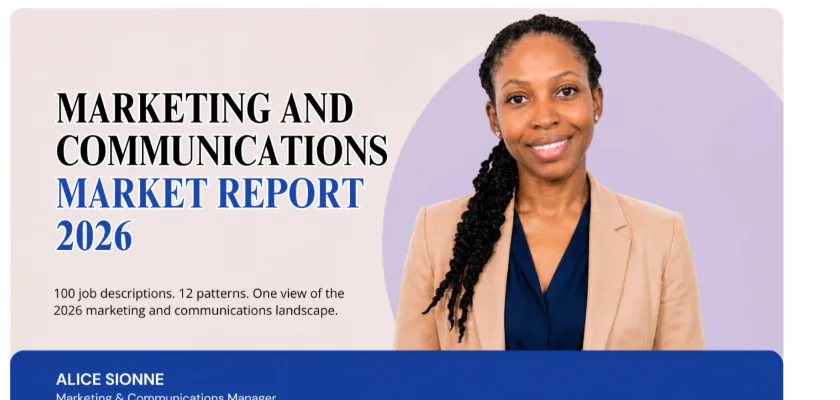
Over 14 days, I reviewed 100 marketing and communications job descriptions while analyzing the current landscape. Patterns are emerging that reflect a massive shift in how senior talent is being valued, balancing creative narrative with aggressive operational execution. The generalist is under pressure. Technical literacy is increasingly becoming a baseline expectation. Internal Communications has moved closer to the strategic center, and AI is becoming the speed layer underneath every senior brief.
The generalist is under pressure. Technical literacy is becoming a baseline expectation. Internal Communications has moved closer to the strategic center, and AI is becoming the speed layer underneath every senior brief.
Here are the 12 patterns I keep coming back to.
1. The market is hiring for fires, not foundations
Hiring volume is increasingly tilting toward specialists: performance marketing, brand activation, and growth operations. The senior leader who can build a function from the ground up, brand strategy, content, performance, internal comms, sales enablement under one roof, appears less often. Brand strategists, growth leads, and content directors are now hired as distinct tracks, not as facets of a single role. Both profiles matter. They serve different needs. But the volume is tilting toward specialists.
2. The depth paradox: channel mastery over integrated strategy
Marketing roles are increasingly defined by deep channel mastery rather than broad integrated strategy. In 2026, briefs are becoming hyper-focused, favoring candidates with deep specialisms in a single track. While the senior generalist is still essential for building foundations, the current market volume is tilting toward specialists who can execute at depth immediately.
3. Founder-led is a category, not a sector
From Beauty, fintech, AI tooling to scaleup SaaS, founder-led environments operate as a distinct hiring category. The core requirement is the ability to translate one person's vision across markets, channels, and cultural moments with extreme speed. It is not about scale. It is about consistency under speed. PR Managers, Creative Marketing Managers, and Marcom Managers in this category are hired on judgment more than process.
4. Internal communications has moved closer to the strategic center
Internal Communications (IC) and Employer Brand (EB) openings posted at sustained pace across aviation, energy, healthcare, fintech, and logistics. Companies are realizing that in a fragmented market, culture and internal alignment are the only sustainable competitive advantages. IC and EB are no longer support functions; they are the strategic anchor for PR and Corporate Comms. If you have multi-market, multinational matrix experience in IC, this is a moment to be visible.
5. ESG: from compliance to narrative
Sustainability is no longer a compliance line; it is a hire-able skill, and appeared as a sub-thread inside several IC and Corporate Communications roles, particularly in energy, logistics, and large group structures. The candidate who can translate complex ESG data into a compelling employee and stakeholder narrative is increasingly valuable. In 2026, compelling must now be defensible. The market wants leaders who can turn regulatory requirements into a story of long-term business resilience.
6. The trust premium: metrics plus narrative
Across every job description, there is a subtext of Trust. Whether it is through verified performance metrics, narrative governance, or transparent attribution, the ability to make a brand's promise (and its ROI) measurable is the highest-value skill in 2026.
7. The senior manager band may now be the rarest configuration in the market
There is a glut of 3 to 5 year Brand Managers and 15+ year Directors. The senior manager band, who bridge strategy and technical execution, is the rarest configuration. It is where the hardest work (and most interesting challenges) live, yet hiring teams have not figured out how to title this band cleanly yet, which makes the search harder for both candidates and employers.
8. Regional multi-market fluency is an advantage
In a globalized market, language requirements are becoming hyper-targeted. Whether it is Arabic, English, French, Hindi, Spanish, or Mandarin, multi-language fluency is being treated as a strategic asset for specific audiences. Multi-language markets reward candidates who can communicate in more than one professional language. Reading the language requirement first saves time on both sides.
9. Salary transparency is a competitive edge
Almost no senior job description publishes a salary band. Candidates are expected to anchor first. The roles that do are attracting higher-quality talent and tend to close faster. At the senior level, transparency is an advantage for employers, not a risk. Hiring teams that experiment with transparency over the next two quarters will compound a small advantage into a real one.
10. Application volume is brutal at the senior level
Most senior roles surfaced with 200+ applicants within 48 hours. Cold applications are the slowest route to entry. Referrals and direct networks are doing more of the heavy lifting than ever before. If you are senior and applying cold, expect the funnel to be slower. If you are hiring, expect the same number of applications to contain a smaller proportion of actual fits.
11. Operational logic beats tool matching
The marketing tool stack has expanded at a pace that outstrips individual mastery. Job descriptions now list dozens of platforms: marketing automation, ABM, CRM, attribution, performance dashboards, content management, creative software, and AI-enabled analytics. The reality is that most senior candidates carry working proficiency in only 30% to 40% of any given stack. Teams that hire on operational logic, brand judgment, and framework fluency over exact-tool match find their hire faster.
12. AI is becoming the speed layer underneath every senior brief
Even if they appear in job descriptions more often than a year ago, AI tools are rarely a disqualifier. Senior roles still hire for human judgment, and stakeholder navigation, but if you are not using AI as a speed multiplier to sharpen your production cycles or data analysis, you risk appearing analog in a digital-first market. Candidates who use AI confidently will move faster than those who do not. The absence of AI fluency is not yet a disqualifier. AI is not taking your job. It is asking you to do it better.
The bottom line
The 2026 market rewards the senior moat: the rare ability to bridge deep channel mastery with the strategic judgment to hold a brand position, an audience map, and an editorial plan in the same breath. Success now depends on three things: channel depth, operational fluency, and the ability to make a brand's promise and its ROI measurable at the same time.
I am currently exploring marketing, brand, and communications managerial roles, particularly where operations, governance and storytelling intersect. If you are hiring in this space, feel free to reach out.
Stay Updated
Get notified when I publish new reflections, insights, and behind-the-scenes updates.