Forbes' 2026 Top Creators list crossed $1 billion: why the creator economy is becoming the media industry
July 7, 2026
Forbes has just released its 2026 Top Creators list, and as you might expect, MrBeast is topping the list with $300 million. But that is not the most significant takeaway.
For the first time in the list's five-year history, its 50 highest-earning creators generated a combined $1.02 billion in estimated earnings between March 2025 and March 2026: up 20% from last year and roughly 80% from Forbes' first list in 2022. But the real shift is deeper than the revenue. Creators are no longer just breaking into entertainment. Instead, they are building the intellectual property, distribution channels, and commercial infrastructure that traditional media once controlled.
After over a decade watching how attention is bought, earned and converted into commercial value, I see a clear structural shift. But before I deep dive into my analysis, here are the key facts you need to know.
Are creators just entering the media industry, or have they become the industry itself?
2026 methodology and top 10 breakdown
Forbes ranks creators using a quantitative framework evaluating three dimensions: estimated gross earnings, audience metrics (provided by Influential), and entrepreneurial activity. Creators receive an entrepreneurial score from 1 (primarily advertising-dependent) to 4 (builders of brands, companies, and services). All earnings figures represent gross income before production costs and taxes.
MrBeast remains the undisputed star, retaining his number one position for the fifth consecutive year. His $300 million in estimated earnings is backed by a staggering 873 million followers across platforms. His media entity, Beast Industries, encompasses production, consumer goods like Feastables, analytics tools, and operations reportedly taking venture investment at a $5 billion valuation.
The earnings disparity between the top and lower tiers is substantial. Dhar Mann, ranked second with $65 million, earned less than one-quarter of MrBeast's total. Here is how the top 10 shakes out.
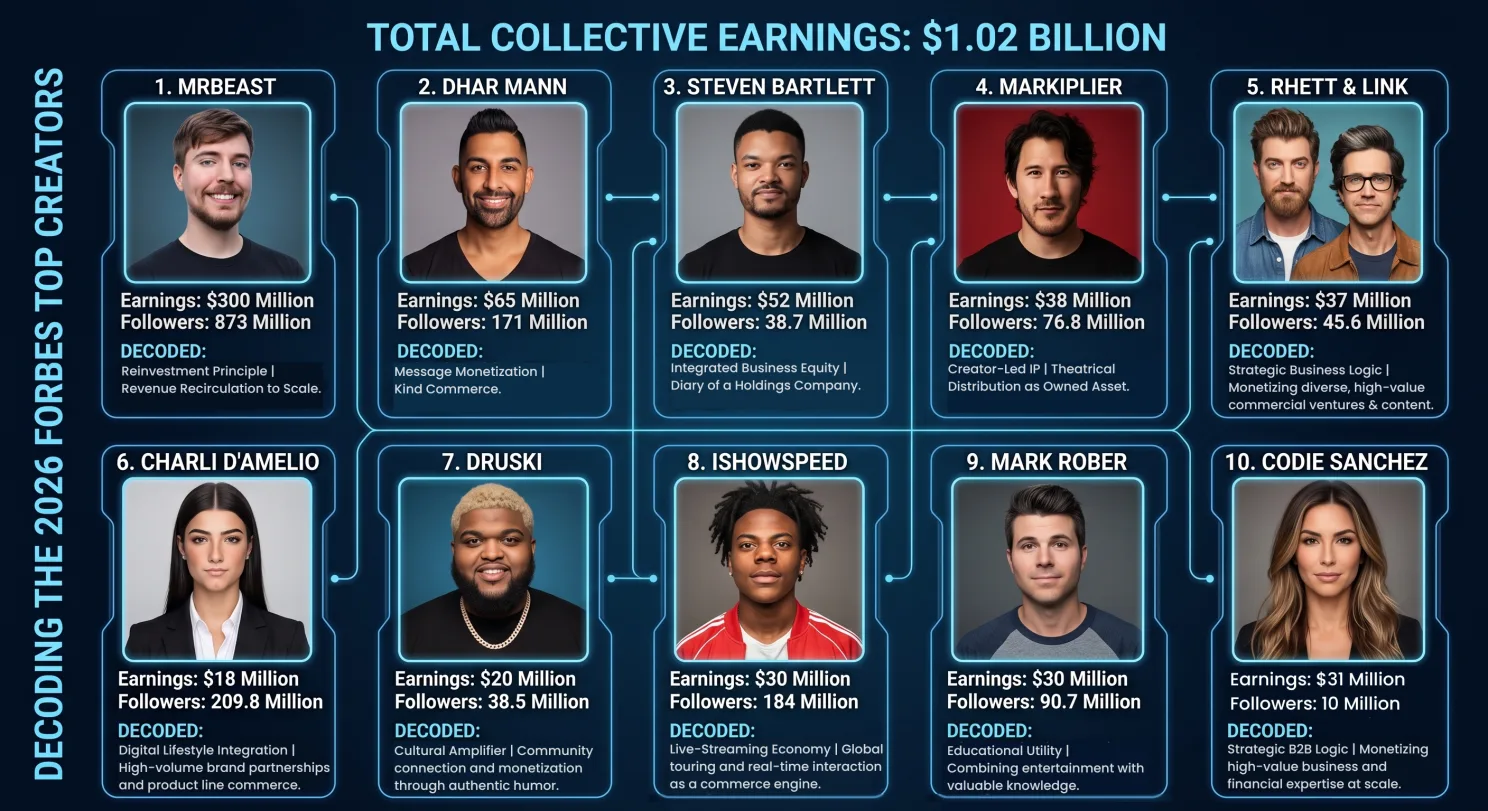
The list shows how concentrated creator earnings have become, with MrBeast's estimated $300 million far ahead of the rest of the field. The full 50 on Forbes includes prominent names like Khaby Lame, Ms. Rachel, Jesser and Alix Earle.
When creator-led IP outperforms traditional Hollywood
The most compelling storyline of 2025 and 2026 is the unprecedented commercial performance of creator-led theatrical releases. While employment in the Los Angeles motion picture industry fell to a historic low in 2025, creators proved their ability to dominate the box office.
- Kane Parsons' Backrooms, adapted from his YouTube horror series, was made for around $10 million and has grossed more than $330 million globally, becoming A24's highest-grossing film.
- Curry Barker's Obsession, made for a reported $750,000, has surpassed $370 million worldwide.
- Iron Lung, self-financed and self-distributed by Markiplier, earned $50 million domestically.
During a single weekend, these two YouTube-origin films overtook Disney and Lucasfilm's The Mandalorian and Grogu, a legacy release with a reported budget of $165 million.
The television landscape tells a similar story. Dhar Mann maintains an always-on channel with Samsung TV and partnered with Fox to produce 40 vertical dramas. His 200-person team drives nearly 300 million weekly views globally. Meanwhile, YouTube expanded its Emmy submissions from three creators in 2025 to seven in 2026, and creators like Mark Rober and Ms. Rachel have successfully brought their programs to Netflix.
Four structural factors driving the shift
This differential between legacy media and the creator class is driven by four things.
- Distribution cost. Platforms like YouTube, TikTok, and Spotify impose zero marginal cost for distribution. Traditional networks incur massive infrastructure and carriage expenses.
- Monetisation architecture. Digital creators maintain direct IP ownership and increasingly hold equity in the brands they promote. They have shifted from vendors to co-owners.
- Production efficiency. While outliers like MrBeast reinvest millions per video, the broader cohort operates with lean models. Interview-based formats like Steven Bartlett's maintain fractional overhead relative to their massive revenue.
- Globalisation of creator capital. IShowSpeed executed a live-streaming tour across 20 African countries in 28 days to unlock new audiences. Khaby Lame's brand rights were central to a corporate transaction utilising an AI digital twin for live-stream e-commerce, illustrating the convergence of creator equity and financial markets.
Contextualising the margins
Forbes measures gross revenue before production costs. While legacy studios operate on 15 to 25% net margins after production and distribution, the 40 to 70% margins often cited for digital creators usually reference operating margins before content production costs. MrBeast's $300 million figure does not reflect his production expenditure, which industry observers suggest approaches near total reinvestment on major projects.
Strategic implications and key takeaways
The global creator economy market was valued at approximately $313.7 billion in 2025 and is projected to reach $500 billion by 2030. With more than 200 million people worldwide identifying as content creators, the landscape is shifting permanently.
If you take away three things from this year's list, let it be these.
- For brands. The 20% year-over-year earnings growth signals a shift in negotiating leverage. Contract architecture requires an immediate overhaul. Usage rights, exclusivity, and content repurposing must be negotiated as independent items rather than bundled into flat fees.
- For traditional media. Traditional studios face a competitive disadvantage in audience acquisition. The creators outperforming massive studio blockbusters built and nurtured their audiences for years before a greenlight was ever given.
- For aspiring creators. Audience scale is not the sole determinant of earnings. Codie Sanchez achieved top-ten placement with only 10 million followers by monetising high-value B2B content. Content format, audience intent, and your monetisation architecture matter just as much as raw reach.
One final question stays with me: does this level of wealth make sense when causes such as education, health, and climate action still fight for funding?
Creators have earned their success by building real businesses and audiences. But the list also shows where attention, and therefore capital, flows most easily. The next question is not only what creators can earn, but what this new influence could help fund, amplify, or change.
Forbes' Top Creators 2026 covers estimated earnings between March 2025 and March 2026. All figures are gross, before production costs and taxes.
Stay Updated
Get notified when I publish new reflections, insights, and behind-the-scenes updates.